

**By Enrico Robotti, MD**
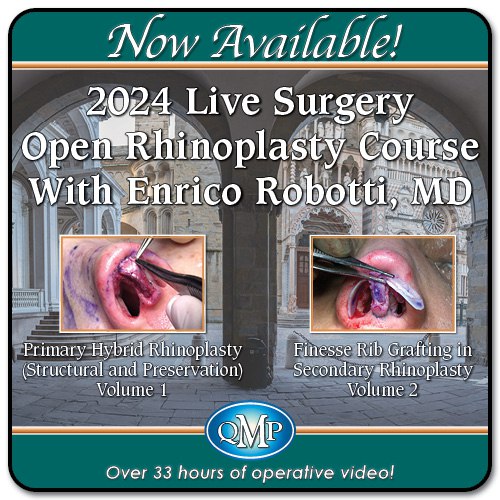
In this distinctive two-volume video series, Dr. Enrico Robotti offers an in-depth exploration of hybrid rhinoplasty techniques, focusing on both structural and preservation methods, as well as advanced rib grafting for secondary rhinoplasty.
**Volume 1** encompasses a comprehensive range of techniques and insights related to state-of-the-art “hybrid” primary rhinoseptoplasty, which effectively merges the strengths of preservation and structural methods. The volume meticulously illustrates various approaches, including cartilaginous push-down, full let-down, and modified cartilaginous push-down with the enclosure of a portion of the bony cap. Additionally, it delineates the structural management of the nasal tip, emphasizing the preservation-reconstruction of ligaments. Techniques for tip and dorsal dissection on subperichondrial-subperiosteal planes are presented, along with a demonstration of three-point compartmentalization aimed at minimizing edema and achieving optimal surface contour. Innovative concepts such as sublaminar septal dissection and the interdomal ligament-septal perichondrial sling are detailed. Each case showcases the combined application of piezoelectric and power tools for osteotomies and osteoplasty, while also addressing the management of the septum and turbinates to ensure functional efficacy.
**Volume 2** extends this discussion by elucidating advanced techniques in rib graft application through four distinct secondary rhinoplasty cases. This volume includes the cutting-edge reconstruction of the nasal dorsum utilizing Dr. Robotti’s proprietary SPF-SPLF graft techniques as well as the inventive use of “rib cartilage plaster.” The septal T “push-up” technique, which integrates facets of both preservation and structural methodologies, is likewise showcased. Given the intricate nature of secondary rhinoplasty, characterized by its steep learning curve, this video series serves to offer practitioners a structured algorithm, flexibility in intraoperative decision-making, meticulous attention to detail, and a repertoire of invaluable tips and tricks. A thorough examination of contemporary instrumentation alongside the proper methodology for rib harvesting—including careful shaping and laminating techniques—further enhances its educational value. The series also underscores the significance of employing precisely crafted rib grafts to minimize bulk and improve aesthetic outcomes while ensuring proper airway management and valve functioning.
Every case within this two-volume compilation includes a detailed preoperative discussion, outlining the proposed surgical plan, followed by an exhaustive demonstration of dissection techniques, step-by-step surgical methodologies, and the final dressing procedures.
**Volume 1**
**Five Clinical Cases with Approximately 20 Hours of Operative Video Documentation**
**Case 1:** A 46-year-old female patient presented with a dorsal hump, a drooping and bulbous tip, wide nasal bones, and associated chin hypoplasia. The surgical approach involved a modified dorsal split hybrid preservation technique, which included osteoplasty, full let-down, and structural tip re-editing utilizing a septal extension graft, along with ligament reconstruction and a septal fusion sling. Additional procedures included sublaminar septal dissection, septoplasty, piezoelectric turbinoplasty, and installation of three-point compartmentalization sutures. Chin augmentation was performed using an anatomical silicone implant inserted intraorally.
**Case 2:** An 18-year-old female patient exhibited a significant dorsal hump, septal deviation, weak tip cartilages, and a mildly recessed chin. The modified dorsal split hybrid preservation was applied, involving osteoplasty, full let-down, and structural tip re-editing with a septal extension graft, spacer strut, and alar contour grafts. Ligament reconstruction and a septal fusion sling were also employed. Complementary procedures included sublaminar septal dissection, septoplasty, piezoelectric turbinoplasty, and three-point compartmentalization sutures, along with lipostructuring of the chin.
**Case 3:** A 24-year-old male patient demonstrated wide and asymmetric nasal bones, middle vault asymmetry, a septal deviation, thin skin, a dorsal hump, an open nasolabial angle, and severe functional issues. The treatment protocol included modified dorsal split hybrid preservation utilizing a modified cartilaginous push-down technique incorporating a portion of the bony cap, midvault reconstruction, and osteotomies alongside osteoplasty. A piezoelectric septoplasty and turbinoplasty were performed, in addition to structural tip re-editing with an auto septal extension graft, ligament sling, asymmetric turn-under/turn-over of lateral crura, spacer strut, and mini alar contour grafts.
**Case 4:** A 25-year-old female patient with a bulbous tip, significant dorsal hump, and very thin skin was treated through modified dorsal split hybrid preservation techniques. This involved osteoplasty, full let-down, and structural tip re-editing utilizing a septal extension graft, along with ligament reconstruction and a septal fusion sling. Further interventions included sublaminar septal dissection, septoplasty, and piezoelectric septoplasty and turbinoplasty. Deep temporalis fascia harvesting was conducted for tailored dorsal camouflage, along with structural tip re-editing utilizing an auto septal extension graft, ligament sling, asymmetric turn-under/turn-over of lateral crura, spacer strut, and articulated grafts.
**Case 5:** A 23-year-old male patient presented with a post-traumatic crooked nose, bony and midvault asymmetry, septal deviation, a drooping, long, and asymmetric tip, excess volume, and significant septal deviation. The management plan employed modified dorsal split hybrid preservation with a cartilaginous push-down technique and piezoelectric septoplasty and turbinoplasty. Rib graft harvesting was performed, utilizing rib laminations for appropriate L-strut septal reconstruction, along with osteoplasty and osteotomies, transosseous sutures for bony fixation, tip reconstruction, and camouflage employing “rib plaster.”
**Volume 2**
**Comprehensive Analysis of 4 Cases Featuring Over 13 Hours of Operative Video**
**Case 1:** Tertiary rhinoseptoplasty conducted on a 32-year-old female patient presenting with nasal deviation, pollybeak deformity, inverted-V configuration, asymmetric nasal tip, bilateral alar retraction, and functional nasal obstruction. The surgical protocol included burr osteoplasty, rib-derived full L-strut reconstruction, extended lateral crura struts, transposition techniques, bilateral composite grafts, a SPLF graft, turbinoplasty, and rib cartilage plaster augmentation.
**Case 2:** Primary rhinoseptoplasty performed on a 22-year-old female patient with congenital maxillary hypoplasia accompanied by saddling, bulbous nasal tip, and deficiencies in the septal and medial crura. The operative techniques employed comprised burr osteoplasty and piezoelectric osteotomies, rib L-strut reconstruction utilizing the septal T push-up method, premaxillary augmentation, and the application of a SPLF graft.
**Case 3:** Quaternary rhinoseptoplasty in a 33-year-old female patient characterized by significant tip asymmetry, pinching, stenosis of both external and internal nasal valves, nasal deviation, right alar retraction, and severe functional obstruction. The surgical approach incorporated burr osteoplasty, piezoelectric wedge ostectomy, complete tip reconstruction, rib lateral crura strut placement, transposition alongside rib full L-strut reconstruction, perichondral grafting, turbinoplasty, and a SPLF graft.
**Case 4:** Tertiary rhinoseptoplasty executed on a 32-year-old male patient following prior trauma, exhibiting nasal deviation, saddling, tip collapse, alar asymmetry, and marked functional obstruction. The surgical intervention involved burr osteoplasty, piezoelectric opening osteotomies, internal valve reconstruction, rib full L-strut reconstruction, tip definition techniques, rib lateral crura strut placement, transposition, and the use of an SPF graft.
This collection is available in HD streaming format and features a total of 9 cases encompassing over 33 hours of operative video. Year of publication: 2024.
